On this page
Planning December parties at parks, farms, beaches or school fields? Many of the best venues have no plug point nearby, which means you need a generator for a jumping castle. Even in town, a power trip or a local outage can flatten an inflatable with children on it. This guide explains how to size a generator for your blower, how to set it up safely, and what to plan for before you buy your first unit or take on outdoor bookings this summer.
Why power planning still matters in 2026
The good news is that national load shedding has largely disappeared. In November 2026 Eskom reported more than 540 days without load shedding and said it is targeting the end of load reduction by March 2027 (Eyewitness News). But a jumping castle depends on its blower running for the entire time it is in use, so any break in supply matters. Local faults, municipal outages, tripped circuits at a venue and simply having no outlet within reach are all reasons you may need your own power source.
An inflatable is not like a trampoline: it only stays firm while air is being pushed into it. If the blower stops, the castle starts to soften and sag within moments. That is why power is a safety issue, not just a convenience.
How to size a generator for a jumping castle
Do not guess. Use the numbers on your own blower and follow this simple method.
- Read the rating plate on each blower. It shows the power in watts (W) or horsepower (HP). As a rough guide, one generator sizing calculator lists running draw of about 900 W for a 1.0 HP blower, 1,300 W for 1.5 HP and 1,700 W for 2.0 HP. Your own blower’s plate is the figure that counts.
- Allow for start-up surge. Electric motors draw more power for a few seconds when they start. A common rule of thumb is to allow about 50% above the running watts for that surge.
- Add headroom. Generators should not be run flat out for hours. Aim for a unit whose continuous rated output stays comfortably above your total, so it is not running at more than about 80% of its capacity for long periods.
- Add every blower and appliance. If you run a combo and a slide off the same generator, or add a sound system or lights, add all of them together.
A worked example with your own numbers
Say your blower plate shows 1,100 W running. Allow 50% for start-up: 1,100 × 1.5 = 1,650 W. Add 20% headroom: 1,650 × 1.2 = 1,980 W. You would then look for a generator with a continuous (not peak) rating of at least around 2,000 W for that one blower. Two of the same blowers on one generator roughly doubles the requirement. If you are unsure, ask a qualified electrician or your generator supplier to check your figures.
Inverter or conventional generator?
- Inverter generators are usually quieter and give a cleaner, steadier output. Quiet matters at children’s parties, restaurants and residential estates.
- Conventional (open-frame) generators usually give more watts per Rand but are louder.
- Check the continuous rating, not the peak rating. The big number on the box is often the short-term peak.
- Fuel runtime. Check how long the tank lasts at your load. A party might run four to six hours, and refuelling a hot generator mid-event is something to avoid.
Generator safety at the event
A generator for a jumping castle brings its own risks. Build these rules into every set-up:
- Exhaust and fumes. Run generators outdoors only, never in a garage, tent or enclosed space, and point the exhaust away from the inflatable, the queue and any seating. Generator exhaust contains carbon monoxide.
- Keep children away. Place the generator well clear of the play area and fence it off or put an adult in charge of it. It gets hot and is noisy.
- Refuel safely. Switch off and let the generator cool before refuelling. Store fuel in an approved container away from the play area.
- Protect the cable run. Use an outdoor-rated extension lead of a suitable rating, keep it as short as practical, and run it where people will not trip over it. Keep connections off wet grass, especially next to water slides.
- Earth leakage protection. Use earth leakage protection on the supply to the blower, particularly near water. A qualified electrician can advise on the right set-up for your generator.
- Stable, dry, level ground. Stand the generator on a firm surface, shaded from rain if possible.
What to do if the power fails
Make this part of your operator briefing before the first child climbs on:
- Get every child off the inflatable immediately and calmly, smallest first.
- Keep children away from the entrance while the castle deflates, so nobody is caught under soft walls.
- Check the generator, fuel, cable and plug, and find the cause before restarting.
- Only let children back on once the inflatable is fully firm again and the anchoring has been checked.
Wind and power go hand in hand on summer afternoons. Read our earlier guide on jumping castle wind safety for anchoring and storm rules.
Which jumping castle suits off-grid sites?
Fewer blowers means a simpler power set-up. A single-blower unit is the easiest to run from one generator. When you request your quotation, ask your consultant to confirm how many blowers come with your unit and their rating, so you can size your generator before delivery. A few options to compare:
- Jumping Castle (3x5m): R13,290, 5 m × 3 m. A compact unit for backyards, parks and smaller parties. Delivery R770 to Gauteng, R1,150 to the Western Cape.
- Commercial Castle 4m: R14,190, 4 m × 4 m. A square footprint that fits tighter spaces. Delivery R780 to Gauteng, R1,160 to the Western Cape.
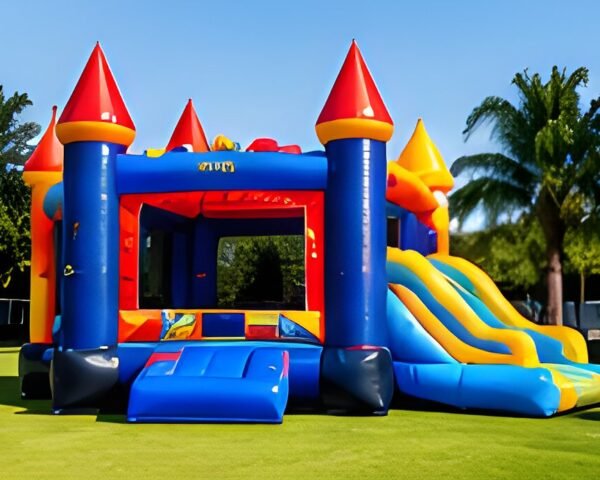
- Combo Inflatable (7x5m): R19,990, 7 m × 5 m. A bigger combo for school fun days and larger parties. Delivery R880 to Gauteng, R1,340 to the Western Cape.
If you are planning several units at one big site, such as a market or a fun day, work out the total blower load first. Splitting units across two generators means one failure does not stop everything.
Off-grid jumping castle checklist
- Blower rating noted from the plate (W or HP).
- Generator continuous rating above running watts plus surge and headroom.
- Fuel for the full event, stored safely away from children.
- Outdoor-rated extension lead, kept short and off wet ground.
- Earth leakage protection in place.
- Generator placed downwind, away from the play area and queue.
- Power-failure procedure explained to every supervising adult.
- Anchoring checked and wind limits agreed.
Buying your castle
See every unit with Rand prices in our jumping castles category. We are a Durban-based supplier of new, commercial-grade inflatables with nationwide delivery priced by weight and shown at checkout. No payment is taken online: a consultant confirms your order first, and formal quotations and invoices are available on request. Check the warranty terms for your unit, and call or WhatsApp +27 63 016 8542 if you want help planning power for your events.
Shop the units in this guide
Frequently asked questions
What size generator do I need for a jumping castle?
Take the running watts from your blower rating plate, add about 50% for start-up surge and about 20% headroom, then choose a generator whose continuous rating is above that total.
Is load shedding still a risk for jumping castles?
Eskom reported more than 540 days without load shedding in November 2026, but local outages, tripped venue circuits and sites without plug points still make a backup power plan important.
What happens if the blower stops?
The inflatable begins to deflate straight away. Get all children off immediately, keep them clear of the entrance, and only restart once the cause is fixed and the castle is fully firm.
Ready to buy? Browse all commercial inflatables, see delivery prices by province, or request a formal quote. A sales consultant confirms every order before you pay.